
Norwalk Records Open for Access
California law does not give every record the same access status. Norwalk public records range from free parcel and license lookups to documents that must be reviewed at a counter or ordered as copies. The custodian matters as much as the subject. Los Angeles County keeps most land and vital files, the Superior Court controls case records, and the City of Norwalk maintains its own permit material.
| Record group | Office that keeps it | Web access | Coverage and channel |
|---|---|---|---|
| Deeds and liens | LA County RR/CC | No official internet index; separate index bridge | Official files from 1851; counter, mail, or fax |
| Birth, death, marriage | LA County RR/CC or CDPH | Limited historical indexes | Copy eligibility depends on record and copy type |
| Civil, criminal, family, probate | LA Superior Court | Case and paid name-search services vary | Portal, clerk terminal, request, or archives |
| Parcels and assessment | LA County Assessor | AIN, address, and map search | Current public portal and GIS layers |
| Building permits | City of Norwalk | Completed-permit and account portals | Web portal or city counter |
| Custody and registries | LASD, CDCR, BOP, California DOJ | Separate official locators | Only legally disclosable status and records |
Sealed, juvenile, adoption, and protected court files are not part of ordinary access. Confidential marriage records are limited to a party or a court-authorized route. DMV data is restricted, and protected addresses may be withheld. A public index also is not the same thing as an official image or a certified copy.
Norwalk Recorder Access Splits
The Los Angeles County Registrar-Recorder/County Clerk, commonly shortened to RR/CC, keeps official real estate records from 1851 forward. Its Norwalk headquarters divides in-person review by year: records from 1851 through 1957 are on the lower level, while records from 1958 forward are reviewed on the second floor. The alphabetical indexes use a party name and recording year. Staff do not perform index searches by phone.
The official index is intentionally absent from the internet. The RR/CC explains that California Government Code section 6254.21 restricts posting home addresses of certain public officials and that the county cannot reliably identify all protected addresses inside the files. The official real estate viewing page shows this access policy and the two-floor date split.
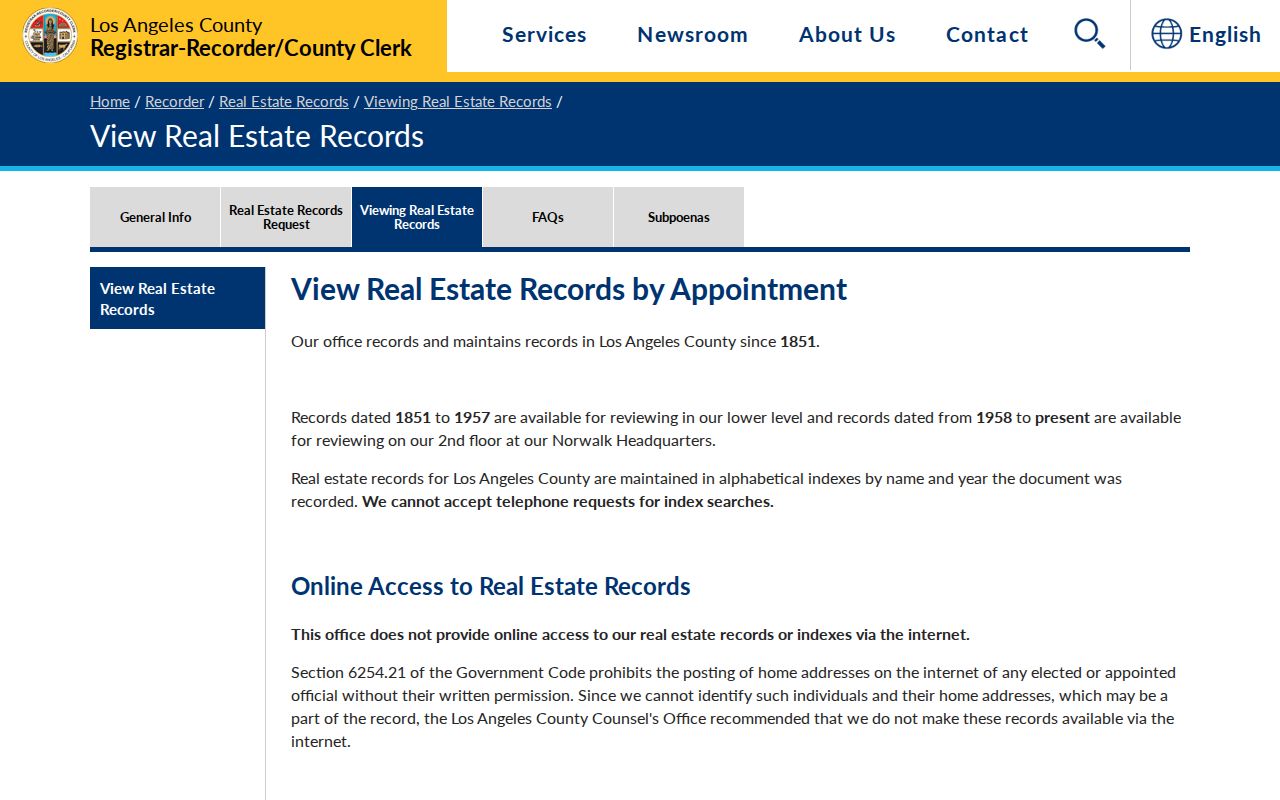
The captured page confirms that the lack of an official web index is a privacy rule, not evidence that the older records were lost.
A separate internet index provides a bridge for grantor and grantee documents from 1977 forward and AIN-linked documents filed after September 2009. It was current through July 7, 2026 when inspected, but official review and copies still come from RR/CC channels.
| Index field | Input | Required | Format or use |
|---|---|---|---|
| Date range from/to | Date or text | Optional | Limits the recording period |
| Name or company | Text | Optional | Searches an individual or organization |
| Signator | Choice | Optional | Grantor or grantee role |
| AIN | Text | Optional | Ten digits, no dashes; post-September 2009 index |
| Document number | Text | Optional | Finds a known instrument number |
Norwalk Property Records by Parcel
Property research starts with the Assessor's Identification Number, or AIN, and the site address. The Los Angeles County Assessor Public Portal accepts an AIN or address and points to legal and map search modes. The research capture verified parcel and assessment functions, but not every field on a sample result. Treat owner or mailing details as record-dependent rather than guaranteed.
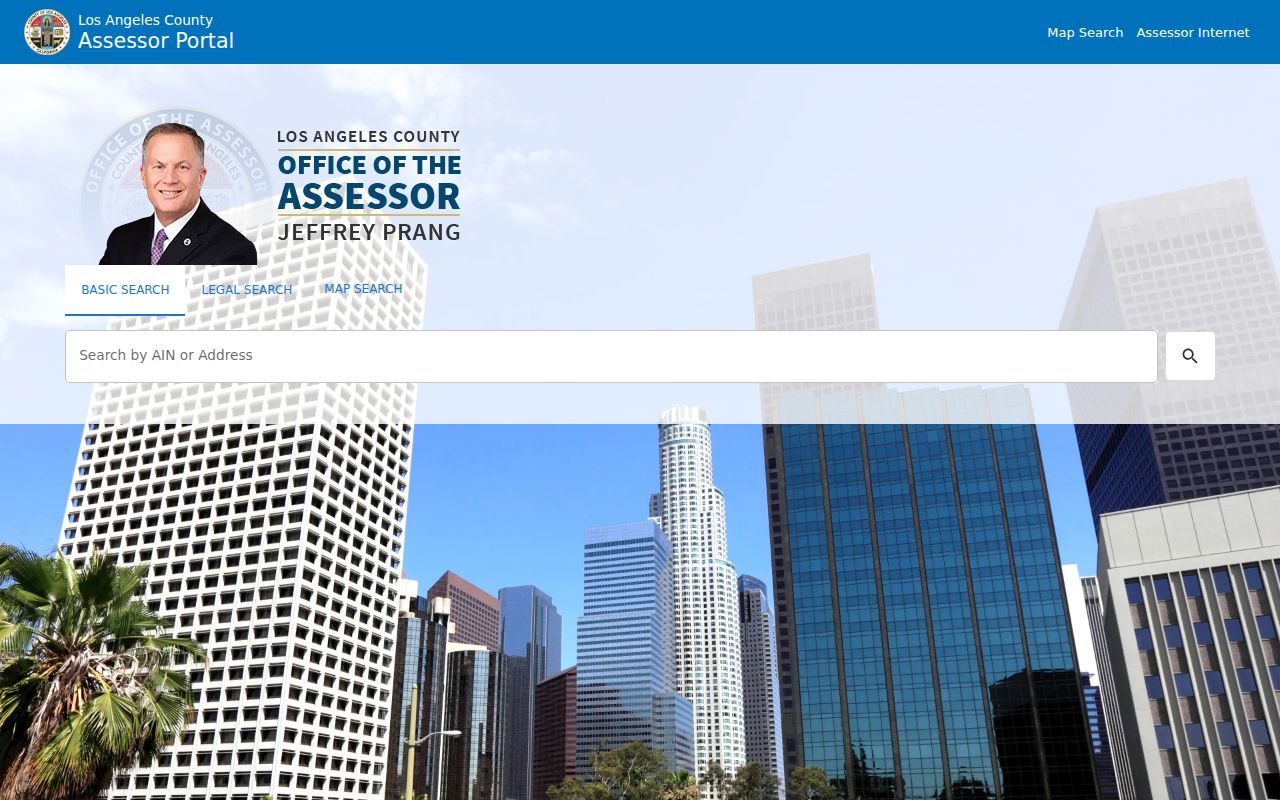
The portal screen is the practical handoff from a street address to the county parcel identifier used in later land-record work.
The Assessor map search adds parcel boundaries and layers for cities, communities, ZIP codes, school districts, supervisorial districts, and single-family clusters. Those layers help establish which agency may hold a related file.
The map view supplies geographic context, while the recorder index supplies names and recorded instruments. City permits form a third track. Norwalk's Public Information Portal covers completed permits, and its Citizen Access Portal supports permit and inspection account actions. An owner-builder permit can be especially useful because the owner shown on the grant deed must present California identification and sign the owner-builder declaration.
Norwalk Court Record Channels
The Southeast District's Norwalk Courthouse is at 12720 Norwalk Boulevard. Countywide Los Angeles Superior Court services route users by case type. The criminal defendant-name search returns a case number, defendant name, filing date, and filing location. It supports exact-match and starts-with searches, updates daily, and charges a nonrefundable cost-recovery fee even when no match is found.
A case number can then open the Case Summary route or support a clerk request. Not every image or detail appears online. Older cases may require the Archives and Records Center, while some files remain available only through a court terminal or clerk. Juvenile, sealed, adoption, and protected portions are restricted. Federal matters use PACER for the Central District of California under separate federal fee and privacy rules.
Norwalk Vital Record Copies
Los Angeles County birth records begin in 1866, death records in 1877, and marriage records in 1852. Birth, death, and nonconfidential marriage records have authorized and informational copy paths under California Health and Safety Code section 103526. An informational certified copy is marked as not valid to establish identity. A confidential marriage copy goes only to a party to that marriage or through a court-authorized route.
County vital-record orders can use online, mail, or in-person channels. Mail requests go to the Birth, Death and Marriage Records Section at PO Box 489, Norwalk, CA 90651-0489. A birth request costs $34, a death request $26, and a marriage request $19. For an authorized birth copy by mail, the application and Certificate of Identity must be signed, and the identity statement must be notarized. The RR/CC birth mail-request page presents the form, identity step, payment method, and mailing route.
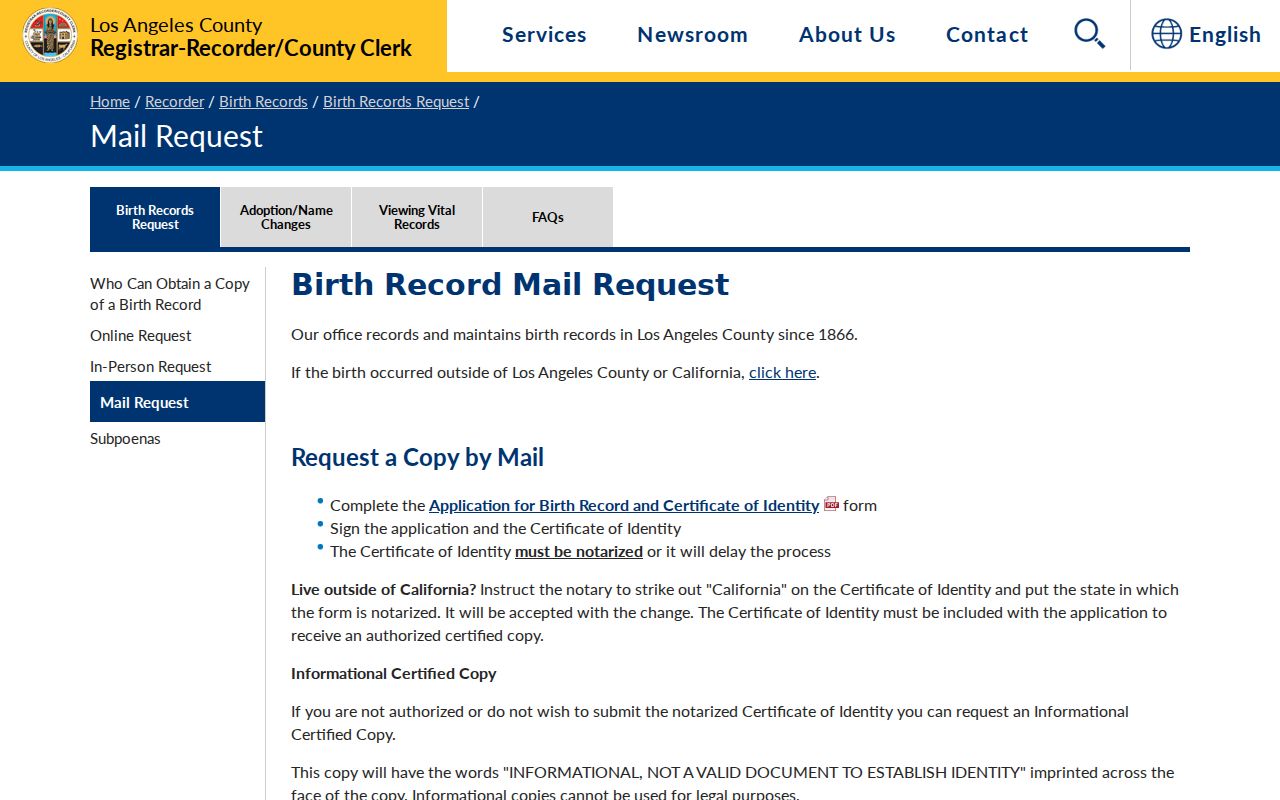
The captured instructions show why a dedicated vital-record form should be used instead of a general CPRA request. Mailed birth requests are processed within 20 business days from receipt.
Norwalk Public Records Custodians
Several major Los Angeles County records desks sit in Norwalk, even though Los Angeles is the county seat. The RR/CC headquarters handles recorder, county clerk, vital-record, and election functions. Court files remain under the Superior Court, while assessment data belongs to the county Assessor.
Real estate copy requests use RR/CC Real Estate Records, PO Box 1130, Norwalk, CA 90651-1130. Vital requests use the separate PO Box 489 address. That distinction prevents a well-formed request from reaching the wrong processing unit.
Pre-1957 Norwalk Records Geography
Norwalk incorporated on August 26, 1957. Material created before that date may be filed as Los Angeles County or community records rather than City of Norwalk municipal records. A failed city search is therefore not proof that no file exists.
For older land, court, probate, and local-history research, broaden place terms to Los Nietos, Santa Gertrudes, Los Coyotes, Downey, Santa Fe Springs, La Mirada, Artesia, and Cerritos. The California State Archives lists county and city record groups such as deeds, probate, naturalization, vital indexes, and Great Registers, but exact Los Angeles County series should be confirmed with archive staff.
Norwalk Custody Record Lookups
Custody information is split by agency. The Los Angeles County Sheriff's Department Inmate Locator searches current county custody by last name, first name, middle name, and date of birth. The California Department of Corrections and Rehabilitation locator covers state custody, and the federal Bureau of Prisons locator covers federal custody, generally from 1982 forward.
California's Megan's Law registry shows only information permitted for public disclosure. Some registrants do not appear, facts can change, and mistaken identity is possible. Its data may be used to protect a person at risk, not to harass or commit a crime. A court case result and a present custody result also answer different questions, so neither should be treated as a substitute for the other.
Norwalk Records Request Timing
The California Public Records Act is codified in Government Code Division 10, sections 7920.000 through 7931.000. Under Government Code section 7922.535, an agency generally has 10 days to decide whether it holds disclosable records described by a request and to state its determination and reasons.
Written notice may extend that determination period by up to 14 days for unusual circumstances. The version effective January 1, 2026 adds cyberattack and emergency-related language. This is a deadline for the agency's determination, not a promise that every responsive file will be produced within ten days. Inspection generally is not priced as a right of access, but copies, certification, and certain electronic extraction work may carry lawful costs.
Request Norwalk Public Records
Use a dedicated service before filing a broad CPRA request. Deeds, vital certificates, and court files each have their own forms, fees, identity rules, and delivery channels. The formal request route is best for agency material not already covered by a normal copy process.
- Identify the custodian. Name the city department, RR/CC division, court, or state agency that created or keeps the file.
- Check its regular access channel. Search the portal, copy page, public terminal, or archive instructions before using CPRA.
- Describe the records, not a question. Give a date range, record type, department, parcel number, document number, or case number when known.
- Choose inspection or copies. State the preferred format and ask the office to identify expected copy costs before processing.
- Track the response. If an exemption applies, review the cited reason, narrow an overbroad request, or seek the agency's review route.
The RR/CC Public Records Act Request Center accepts requests and lets users browse published requests for material outside the office's dedicated record-order systems.
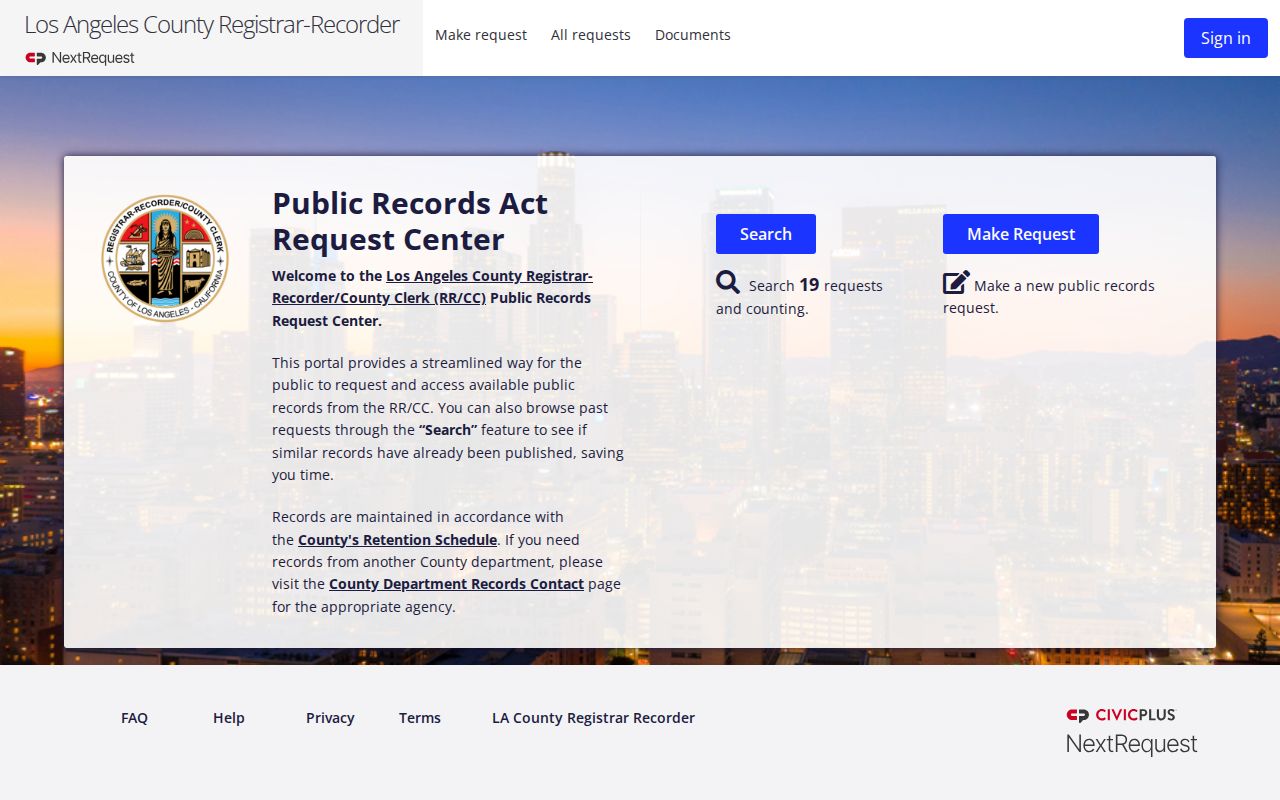
The request-center screen provides a distinct channel from deed-copy and certificate applications. For a real estate mail order, include the document title and number, names on the document, recording date, and address if known. Plain copies cost $5 for the first page plus $3 for each added page; certified copies cost $6 for the first page plus $3 for each added page. Expedited mail or UPS service is $18.50.
Norwalk Records Terms Decoded
A few terms separate a quick lookup from an official record. Read the office's label closely before paying for a search or copy.
- Custodian
- The agency or office responsible for keeping and responding for a record.
- Index
- A finding list with names, dates, or document numbers. It may not include the filed image.
- Certified copy
- A copy the custodian formally attests as a true copy of its record.
- AIN
- The ten-digit Assessor's Identification Number used to identify a Los Angeles County parcel.
- Exemption
- A legal basis for withholding all or part of an otherwise responsive record.
For deeds, grantor means the party transferring an interest and grantee means the party receiving it. Those roles help distinguish people with similar names in a long index.
Norwalk Records With Access Limits
Closed and redacted records follow specific rules. Authorized vital copies require proof or a sworn statement, while informational copies carry a clear identity-use limit. Safe at Home participants may use a substitute address in records generated by California agencies. Voter files have approved-purpose and security rules, and the personal voter-status lookup is not an open search for other people.
Accuracy also has limits. A name match may belong to someone else, an index may omit the image, and a current portal may not reach an older paper file. Confirm identity with dates, locations, record numbers, and the office that keeps the underlying document.
Lawful personal use. Use Norwalk records for legitimate family, estate, property, civic, or safety research. Never use a record to stalk, harass, threaten, or harm a person.